Digital and Brain Fog
Guideline: Mechanism - no clinical guideline; anchored via screen time and attention research
Medically reviewed by Dr. Alexandru-Theodor Amarfei, M.D.
First published
Quick Answer
Digital brain fog is a pattern of attention fragmentation, reduced mental clarity, and difficulty sustaining focus that gets worse with heavy screen load, notifications, and late-night device use and often improves when digital inputs are simplified.
Key Takeaways
Fast read- 1
Digital brain fog usually feels context-dependent and mentally fragmented rather than uniformly slow all day.
- 2
Phone proximity alone can reduce available cognitive capacity, and a 2025 trial found that blocking mobile internet improved sustained attention and well-being.
- 3
Notification density may matter as much as total screen hours, which is why a notification audit is often more useful than a generic time limit.
- 4
Late-night screen use can worsen next-day fog by shifting circadian timing and reducing alertness.
- 5
If the pattern is lifelong, cross-setting, and unchanged on low-screen days, screen overload may be an amplifier rather than the primary cause.
- 6
The most useful first experiment is usually not a supplement. It is physical phone distance, fewer notifications, and a screen-light final hour before bed.
Historical Context
Latest Developments in Digital Brain Fog Research
These are the additions most worth integrating into the page now because they sharpen the advice without drifting into hype.
▼
Historical Context
Latest Developments in Digital Brain Fog Research
These are the additions most worth integrating into the page now because they sharpen the advice without drifting into hype.
Blocking mobile internet improved sustained attention
Castelo et al. ran a randomized trial showing that blocking mobile internet on smartphones improved sustained attention, mental health, and subjective well-being. This is one of the strongest intervention studies now available for the page.
The brain-drain effect held up, but not uniformly
Bottger et al. published a meta-analysis confirming an overall negative effect of smartphone presence on cognition while also showing meaningful heterogeneity. That nuance helps the page avoid turning one famous paper into a universal law.
Replication in adults aged 20-34
Skowronek et al. found that smartphone presence reduced basal attentional performance in young adults. This supports the core phone-proximity claim with newer adult data.
Social-media abstinence helps, but not by itself
de Hesselle and Montag found that a 14-day social-media abstinence reduced screen time, but the mental-health effects were more nuanced. The page should frame abstinence as a tool, not a cure-all.
Detox studies are useful, but not all equivalent
Lemahieu et al. found that a short social-media break can improve some outcomes, but the effect size and durability depend on what is being restricted and what replaces it. This supports a more structured, experiment-based detox approach instead of grand promises.
Sleep experts now emphasize timing, content, and habits together
Hartstein et al. published a National Sleep Foundation consensus statement showing that the sleep impact of screens is real, but it depends on timing, content, and behavior patterns rather than blue light alone.
Notifications create their own strain cost
Ohly and Bastin showed that communication-app notifications affect both performance and strain. This helps explain why notification cleanup can matter even when total screen hours are not extreme.
Evening screen light and next-day fog
Chang et al. and Cajochen et al. remain the clearest evidence chain linking late-night light-emitting screens to circadian disruption and reduced next-morning alertness.
When to expect improvement
Hours to 2 weeks, depending on what is driving the pattern
Phone-distance effects can show up the same day, sleep-related gains often take several nights, and broader digital-cleanup trials are more fairly judged over 1 to 2 weeks.
Is Digital Brain Fog Reversible?
Digital overload brain fog is fully reversible. Cognitive capacity returns quickly once digital environment is simplified. The challenge is maintaining new habits in a world designed to fragment attention.
Digital Brain Fog vs ADHD, sleep-related fog, and brain rot
These comparisons matter because digital overload often amplifies another primary driver rather than replacing it.
Digital vs ADHD
Open ADHDDigital overload is more likely when the fog is tightly linked to screen saturation and improves when the phone is gone. ADHD is more likely when the attention problem was lifelong, cross-setting, and already present before heavy smartphone use.
Key question: Was the pattern clearly there before the current device environment took over?
Digital vs Sleep-related fog
Open SleepSleep-related fog usually feels heavier and more uniform, especially on waking. Digital fog often has a stronger screen-load relationship and may improve quickly when device rules change.
Key question: Does the same heavy fog persist on genuinely low-screen days with better sleep opportunity?
Digital vs depression
Open DepressionDepression fog usually travels with low mood, anhedonia, or psychomotor slowing most days. Digital overload is more likely when function breaks mainly during high-scroll, high-interruption periods.
Key question: Is the main story mood collapse, or attention fragmentation in a high-input environment?
Digital vs cervical strain
Open CervicalIf the fog comes with neck pain, headache, visual strain, or a posture-linked pattern, the phone may still matter but cervical or migraine overlap may be doing more of the work than the apps themselves.
Key question: Does head position, neck strain, or migraine biology explain more of the pattern than the notifications do?
Digital brain fog vs brain rot
Stay on DigitalBrain rot is a narrower, lower-depth passive-consumption pattern most associated with compulsive short-form scrolling and a shrinking tolerance for long-form thinking. Digital brain fog is broader and also includes notification overload, app switching, and sleep spillover.
Key question: Is the main problem compulsive low-quality content consumption, or a wider phone-and-notification environment that fragments attention all day?
Visual Guides
Attention guide
Phone Distance and Cognitive Load
A practical visual of the intervention the literature actually supports: more distance, fewer interruptions, better odds of deep focus.
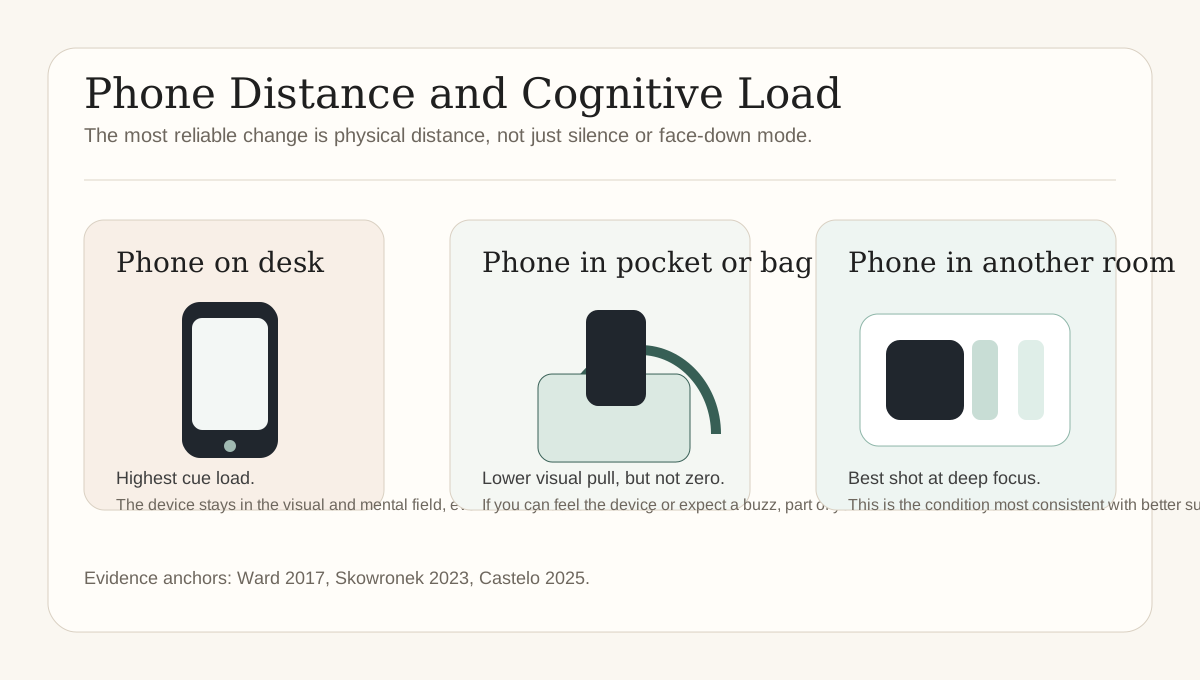
Best used alongside the phone-presence and notification sections, not as proof that every person responds identically.
Recovery guide
Digital Brain Fog Recovery Timeline
A practical timeline for what may improve within hours, days, and 1 to 2 weeks when the environment changes.
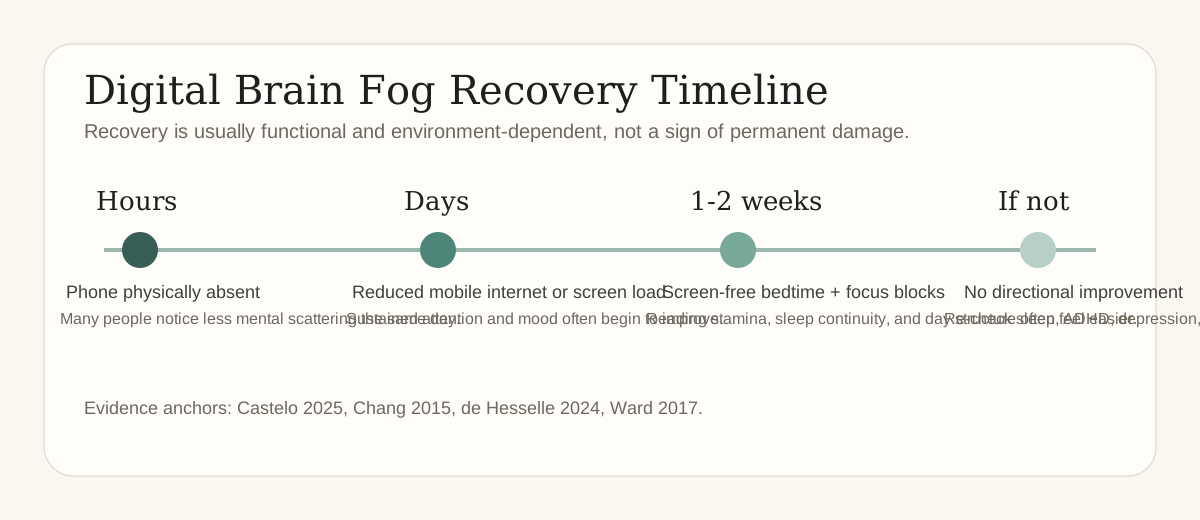
Use this as a practical recovery guide, not a guarantee.
Understanding Your Self-Assessment Results
Digital overload is usually evaluated with behavior data and symptom patterning, not a blood panel. These tools are useful when they move the conversation from vague impressions to objective examples.
Screen Time or Digital Wellbeing report
Use the report to show your real totals, your highest-friction apps, and whether the worst-use days match the worst-focus days.
Bergen Social Media Addiction Scale
A high score suggests compulsive social-media use may be part of the problem and makes a behavioral-treatment discussion more reasonable.
Internet Addiction Test
This is an older but still recognizable screening tool for problematic internet use. It is more useful as a pattern cue than a diagnosis.
ASRS-v1.1, PHQ-9, and GAD-7
If the digital story is muddy, ADHD, depression, and anxiety screens often clarify whether the device is the primary cause or just an amplifier.
Practical Tool
Digital Next-Step Chooser
Pick the version of the story that sounds closest. The goal is to stop guessing whether the problem is the device itself, sleep spillover, a lifelong attention pattern, or compulsive use that needs more support.
That pattern fits digital overload better than a fixed neurological decline. The highest-yield move is not a productivity app. It is changing the environment so the phone is physically absent during focused work.
Best next moves
- • Run one 90-minute block with the phone in another room, not face down on the desk.
- • If that helps, repeat the experiment for 3 to 5 work blocks before deciding whether the effect is real.
- • Track whether the improvement shows up in reading stamina, working memory, and irritability rather than only in productivity.
Best handoff pages
Practical Tool
Notification Audit
Total screen time is a blunt instrument. A better first pass is to sort your notifications into what truly needs your attention now, what can be batched, and what is mostly cognitive noise.
Sort your common alerts
Calls from key people
Texts from family / partner / childcare
Bank / fraud alerts
Calendar reminders
Work chat pings
Delivery / travel updates
News alerts
Likes / follows / comments
Shopping promos
Game streaks / rewards
Keep on
Reserve this for time-sensitive notifications that would clearly matter if you missed them.
- • Calls from key people
- • Texts from family / partner / childcare
- • Bank / fraud alerts
Batch
These are usually better checked on your schedule than pushed into your attention all day.
- • Calendar reminders
- • Work chat pings
- • Delivery / travel updates
Turn off
If it does not protect safety, logistics, or urgent relationships, it probably does not deserve immediate access to your working memory.
- • News alerts
- • Likes / follows / comments
- • Shopping promos
- • Game streaks / rewards
Evidence notes
Notification interruptions are linked to worse performance and higher strain, and newer digital-intervention research suggests that cleaner device rules can improve attention even without deleting every app.
Cause Visual
Digital Pattern Map
Pattern-focused visual for Digital with mechanism, timing, action, and clinician discussion cues.
The Digital-Brain Fog Connection
Digital-related fog usually feels context-dependent: much worse during screen-heavy, notification-heavy, multitasking days and better when the environment is simplified.
What this pattern often feels like
These community-grounded clues are here to help you recognize the shape of the pattern. They are not a diagnosis.
Digital-related fog usually presents as an environment-dependent fragmentation pattern tied to screens, notifications, and multitasking rather than a fixed neurological decline.
Differentiator question: Does the fog improve when screen load, interruptions, and digital context are stripped down hard?
Digital overload may be central, but ADHD, anxiety, poor sleep, migraine, or cervical strain may amplify why the effect feels so strong.
What Digital Brain Fog Usually Feels Like
This section is about the subjective feel of the pattern. The practical timing clues stay in the pattern section below; this part is just about how the fog tends to feel from the inside.
Attention fragmentation: feeling mentally chopped up instead of steadily slowed down.
Lower reading stamina: short-form content feels easy, long-form reading feels harder than it used to.
Reduced working-memory traction: you lose the thread faster after pings, tabs, or app switches.
Late-screen spillover: the next day feels worse after scrolling, gaming, or laptop work close to bedtime.
Fast relief with environmental simplification: your head clears more quickly than expected when the phone is physically out of reach.
Context dependence: the pattern often worsens on high-screen, high-notification days and improves on low-input days.
None of these feelings are unique to digital overload, so compare them against sleep problems, ADHD, depression, migraine, and other nearby causes.
Passive vs Active Screen Use
Not all screen time behaves the same way. The lower-depth, more compulsive end of digital use is usually passive and interruption-heavy: scrolling, checking, refreshing, switching, and consuming without much cognitive effort. Purposeful screen use such as writing, learning, designing, or having a focused conversation is not cognitively identical to that pattern.
Passive use is more likely to pair with notification checking, app switching, and short attention windows.
Active use is more likely to involve goal-directed behavior, longer task engagement, and less compulsive checking.
For many people the problem is not total device exposure alone. It is a high ratio of passive, interruptive, low-depth use.
If your day is digitally heavy but mainly active, creative, or work-directed, the device may still be part of the story, but notification load, sleep spillover, and overlap causes deserve more weight than raw hours alone.
That is why this page cares more about screen pattern, notification density, and bedtime behavior than raw hours alone.
Screen Time and Sleep: Why Nights Matter More Than Totals
Late-night device use is one of the cleanest ways digital overload spills into next-day brain fog. The sleep cost is not just blue light. Timing, emotional arousal, content, and the habit of taking a mentally stimulating device into bed all matter.
Light-emitting screens late in the evening can shift circadian timing and reduce next-morning alertness.
Stimulating content, app switching, and emotional arousal can keep the brain cognitively 'on' even when the device is dimmed.
That is why a phone-free last hour before bed is usually a better experiment than buying another filter or setting change.
If mornings stay just as heavy after a real bedtime-screen trial, sleep apnea or another sleep disorder rises on the list.
Brain Rot vs Digital Brain Fog
The newer 'brain rot' term is useful when it is kept in bounds. It usually refers to the low-depth, mentally dulled state linked to compulsive passive consumption of low-quality digital content, especially short-form scrolling. Digital brain fog is broader.
Brain rot is best treated as a sub-pattern of digital brain fog, not a formal diagnosis.
It is most relevant when the main problem is compulsive passive consumption and a shrinking tolerance for long-form thinking.
Digital brain fog also includes notification load, app switching, sleep spillover, and context-dependent fragmentation.
Use the term descriptively, not diagnostically. It helps name a recognizable passive-consumption pattern, but it does not replace a medical differential.
Two-Week Digital Reset Protocol
This is the most evidence-aligned version of a digital detox: less heroic abstinence, more structured environment change that you can actually measure.
Days 1-3: Phone distance first
Move the phone fully out of reach during one real focus block each day. Do not rely on face-down mode or silent mode alone.
Days 4-7: Notification cleanup
Turn off all non-essential alerts. Keep only calls, messages from key people, and time-sensitive logistics.
Days 8-10: Fix the bedtime spillover
Protect the last 60 minutes before bed from scrolling, gaming, and laptop work. Compare next-morning clarity.
Days 11-14: Reduce passive consumption
Replace one daily block of passive scrolling with reading, conversation, walking, or another active task that requires sustained attention.
This is not about a perfect detox. The test is whether thinking gets steadier when phone proximity, notifications, bedtime screens, and passive scrolling all come down together.
Digital Brain Fog Symptoms: How It Usually Shows Up
These are pattern signals, not proof by themselves. Use them to guide what to measure, compare, and discuss next.
The fog is often worst after late scrolling, late gaming, or laptop use close to bedtime, then eases on days when evening screens are cut down.
High-notification, high-multitasking days tend to feel mentally chopped up rather than uniformly slow.
Clarity often returns faster than expected when the phone is physically absent and mobile internet or notifications are reduced hard.
People often notice that long-form reading, writing, and single-task work feel harder than short, high-switching digital tasks.
What to Try This Week for Digital
- 4
Drink a glass of water now. Keep a bottle visible. Aim for pale yellow urine. Don't overthink it - just drink regularly.
Weekly focus: Hydration.
- 5
Open a window for 15 minutes. Fresh air exchange reduces indoor pollutants. If outdoors is bad (pollution, pollen), use a HEPA filter.
Weekly focus: Environment.
- 6
Reach out to one person today. Text, call, walk together. Isolation worsens every cause of brain fog. Connection is a biological need, not a luxury.
Weekly focus: Connection.
- 7
Rate your brain fog 1-10 each morning for 7 days. Note sleep quality, food, exercise, stress. Patterns emerge within a week.
Weekly focus: Tracking.
Is Digital Brain Fog Reversible?
Digital overload brain fog is fully reversible. Cognitive capacity returns quickly once digital environment is simplified. The challenge is maintaining new habits in a world designed to fragment attention.
Typical timeline: Phone-free deep work block: immediate improvement in that session. Consistent digital boundaries: noticeable pattern change within 1-2 weeks. Habit formation: 4-8 weeks for new defaults to feel natural.
Factors that affect recovery:
- Notification and interruption frequency (every interruption has cognitive cost)
- Phone presence (even a visible phone occupies cognitive resources)
- Screen time before bed (affects sleep quality and next-day cognition)
- Social media usage patterns (passive scrolling vs active engagement)
- Work environment demands (some jobs require high digital load)
Source: Ward et al., JACR, 2017; Mark et al., CHI, 2008
When to talk to a clinician about digital brain fog
The page is primarily about self-management, but a clinician should enter the picture sooner when the digital story is not clean.
The pattern is not improving
If a serious 1 to 2 week trial of phone distance, notification cleanup, and screen-light evenings does nothing, another cause may be carrying more of the story.
The symptoms feel lifelong
That raises ADHD higher on the list and changes the conversation from detox language to formal screening and history.
Mood or anxiety are central
If low mood, panic, compulsive checking, or severe irritability are prominent, use PHQ-9, GAD-7, and behavioral-health follow-through instead of self-blame.
There are red flags
Sudden onset, seizures, focal neurologic symptoms, fever with confusion, or rapidly progressive decline are urgent medical problems, not a screen-time story.
Useful next links
These are the highest-yield follow-through pages if the digital pattern looks real but not clean.
ADHD overlap and screening
Best next page when the attention problem feels lifelong or cross-setting.
Sleep overlap
Use this when the fog is heavy on waking or tracks with bedtime screens.
Brain self-tests
Useful for bringing ASRS-v1.1, PHQ-9, or GAD-7 into the comparison.
Brain fog diet
Best next page when meal timing, distracted eating, or ultra-processed-food overlap still looks important.
Supplements guide
Useful mainly for overlap problems like sleep timing or general cognition support, not as the core fix for digital overload itself.
Glossary
Best next page if terms like melatonin, circadian rhythm, working memory, FoMO, or telepressure are part of the story.
Food Approach
Primary Option
Steady Meals - No Fasting
For conditions where blood sugar stability or regular energy intake is critical. Anti-crash eating.
Eat every 3-4 hours. Never skip meals. Protein + fat + complex carb at every meal. No intermittent fasting. No caffeine on empty stomach. Protein FIRST at each meal (stabilizes glucose). Light snack before bed if morning fog is an issue.
Eat meals away from screens. The act of screen-free eating improves both digestion and attention. Don't snack while scrolling - it disconnects eating from satiety signals.
Open primary diet pattern →Alternative Options
Gentle Anti-Inflammatory (Recovery-Adapted)
For people who are too fatigued, nauseous, or overwhelmed for complex dietary changes. The minimum effective dose.
Small, frequent, simple meals. Broth/soup if appetite is poor. Add ONE portion of oily fish per week. Add berries when tolerable. Reduce (don't eliminate) ultra-processed food. Hydrate. Don't force large meals.
Open this option →Iron-Repletion Focus
For confirmed or suspected iron deficiency. Pair iron-rich foods with vitamin C. Separate from tea/coffee/dairy.
Iron-rich foods: red meat 2-3x/week, liver 1x/week (if tolerated), lentils, spinach, fortified cereals. ALWAYS pair with vitamin C (bell pepper, orange, kiwi, strawberry). Avoid tea/coffee within 1hr of iron-rich meals. Continue prenatal vitamins if postpartum.
Open this option →How to Talk to Your Doctor About Digital and Brain Fog
Suggested Script
"I want to systematically evaluate whether Digital is contributing to my brain fog and compare it against close alternatives."
Tests To Discuss
- • Screen Time or Digital Wellbeing report
- • Bergen Social Media Addiction Scale
- • ASRS-v1.1 if attention problems feel lifelong and cross-setting
- • PHQ-9 / GAD-7 if low mood or anxiety is traveling with the fog
Differentiator Questions
- • Does cognition improve quickly with phone/notification removal and focus blocks, or is fog still severe despite low screen exposure and adequate sleep opportunity?
- • Were attention/executive symptoms lifelong and cross-setting, or mainly amplified by current high-notification/screen environment?
- • Is low mood and anhedonia driving cognition most days, or does focus mainly break during high-scroll/high-interruption periods?
- • When symptoms flare, do they reliably occur 1-3 hours after meals and improve when meal composition changes?
Quiet next step
Get the doctor handout for this pattern
Get the printable doctor handout for this pattern and keep the next steps in one place. No funnel, just the handout and a quiet email reminder if you want it.
How Digital Brain Fog Connects Across The Site
Protocol Guides
Clarity Code Factors
- Dysregulation
Circadian, autonomic, or stress-regulation instability often drives fluctuating fog patterns.
- Depletion
Nutrient, oxygen, or energy substrate deficits reduce cognitive reserve and day-to-day reliability.
Quick Summary: Digital Brain Fog Key Points
Informative- 1
Digital-related fog usually feels context-dependent: much worse during screen-heavy, notification-heavy, multitasking days and better when the environment is simplified.
- 2
Worse in the morning: Digital can present with morning-heavy fog when sleep or overnight physiology is relevant.
- 3
After-meal worsening: Post-meal worsening can strengthen Digital when metabolic or inflammatory triggers are involved.
- 4
Worse after exertion: Post-exertional worsening can increase confidence for Digital when recovery capacity is reduced.
- 5
Story language directly matches a recurring Digital pattern rather than broad fatigue alone.
- 6
Symptoms recur with a repeatable trigger/timing pattern that is physiologically plausible for Digital.
- 7
Context clues (history, exposures, or coexisting conditions) support Digital as a priority hypothesis.
- 8
At least two independent signals point in the same direction without strong contradiction.
- 9
Response to relevant interventions tracks closer with Digital than with Sleep Apnea.
- 10
A competing cause (Sleep Apnea) has stronger direct evidence in the story.
Metabolic Lens
Secondary overlapDigital fog is usually more context-dependent than metabolic fog. It often tracks with notifications, screen saturation, and bedtime screen use rather than a true crash-and-recover physiology pattern.
- Digital overload usually looks mentally chopped up, distractible, and easier to reverse when the environment changes.
- If the fog reliably clusters after meals, standing, or exertion, a metabolic or autonomic explanation rises in priority.
- Sleep disruption is the most common bridge between digital overload and next-day brain fog.
Pattern clues help, but they are not enough by themselves. If the same fog persists on low-screen days, another cause deserves more attention.
12 Evidence-Based Insights About Digital and Brain Fog
Digital brain fog is usually a functional, environment-dependent pattern. The goal is to separate what the evidence really supports from the internet folklore around phones and attention.
Evidence grades: A = strong human evidence, B = moderate evidence, C = preliminary or small-study evidence. Full grading guide
1 DO THIS NOW: Put your phone in another room for one focused block.
▼
DO THIS NOW: Put your phone in another room for one focused block.
The strongest digital-attention studies do not require heroic detoxes to show an effect. Physical distance is the intervention, not just silence or face-down mode.
Ward et al., JACR 2017 DOI ↗
2 A 2023 Scientific Reports replication found that the mere presence of a smartphone reduced basal attentional performance in young adults.
▼
A 2023 Scientific Reports replication found that the mere presence of a smartphone reduced basal attentional performance in young adults.
This supports the original brain-drain finding while avoiding the overclaim that every replication is identical.
Skowronek et al., Sci Rep 2023 DOI ↗
3 Interrupted work carries a real performance cost, but the famous 23-minute number comes from observational knowledge-work research, not a universal rule for every interruption.
▼
Interrupted work carries a real performance cost, but the famous 23-minute number comes from observational knowledge-work research, not a universal rule for every interruption.
The useful takeaway is that interruptions are cognitively expensive enough to justify aggressive environment design.
Mark et al., CHI 2008 DOI ↗
4 A 2025 randomized trial found that blocking mobile internet for two weeks improved sustained attention, mental health, and well-being.
▼
A 2025 randomized trial found that blocking mobile internet for two weeks improved sustained attention, mental health, and well-being.
That matters because it supports reversibility: the pattern is often functional and responsive to behavior change, not obviously fixed.
Castelo et al., PNAS Nexus 2025
5 Evening light-emitting screens shift circadian timing and reduce next-morning alertness.
▼
Evening light-emitting screens shift circadian timing and reduce next-morning alertness.
That is one reason digital brain fog often feels worst after late scrolling, gaming, or laptop work in bed.
Chang et al., PNAS 2015
6 A 2024 abstinence study found that a 14-day social-media break reduced screen time, but mood changes were not dramatically different from controls.
▼
A 2024 abstinence study found that a 14-day social-media break reduced screen time, but mood changes were not dramatically different from controls.
That keeps the page honest: a break can help, but it is not magic if sleep, stress, and compulsive habits stay unchanged.
de Hesselle and Montag, BMC Psychol 2024
7 Notification load deserves its own attention.
▼
Notification load deserves its own attention.
A 2023 occupational-health study found that communication-app notifications can increase strain and hurt performance. That is why a notification audit often matters more than staring at a raw daily screen-time number.
Ohly and Bastin, J Occup Health 2023
8 A 2023 meta-analysis found an overall negative effect of smartphone presence on cognition, but also meaningful heterogeneity.
▼
A 2023 meta-analysis found an overall negative effect of smartphone presence on cognition, but also meaningful heterogeneity.
That nuance matters: the effect is real, but not every task and every person is affected equally.
Bottger et al., Behav Sci 2023
9 Sleep specialists now emphasize that the bedtime-screen story is not just about blue light.
▼
Sleep specialists now emphasize that the bedtime-screen story is not just about blue light.
Timing, emotional arousal, content, and device habits all matter. That is useful because it keeps the page from overselling glasses and underselling bedtime behavior.
Hartstein et al., Sleep Health 2024
10 Screen-free eating is not a gimmick.
▼
Screen-free eating is not a gimmick.
Distracted-eating research shows that when attention is split during meals, awareness of intake and satiety worsens. Meals are one of the easiest places to practice single-task attention again.
Robinson et al., Am J Clin Nutr 2013
11 The newer 'brain rot' discussion is worth keeping in bounds.
▼
The newer 'brain rot' discussion is worth keeping in bounds.
It is best understood as a sub-pattern of digital brain fog linked to compulsive passive low-quality content consumption, not as a formal neurological diagnosis.
Recent reviews on 'brain rot' and digital-content-related cognitive decline
12 If you repeatedly fail to cut back despite real impairment, that is the point where behavioral treatment becomes reasonable.
▼
If you repeatedly fail to cut back despite real impairment, that is the point where behavioral treatment becomes reasonable.
A meta-analysis of treatment studies for problematic internet use found that psychological interventions, especially CBT-style approaches, can help.
Winkler et al., Clin Psychol Rev 2013
View all 12 citations ▼
- Ward et al., JACR 2017 doi:10.1086/691462
- Skowronek et al., Sci Rep 2023 doi:10.1038/s41598-023-36256-4
- Mark et al., CHI 2008 doi:10.1145/1357054.1357072
- Castelo et al., PNAS Nexus 2025
- Chang et al., PNAS 2015
- de Hesselle and Montag, BMC Psychol 2024
- Ohly and Bastin, J Occup Health 2023
- Bottger et al., Behav Sci 2023
- Hartstein et al., Sleep Health 2024
- Robinson et al., Am J Clin Nutr 2013
- Recent reviews on 'brain rot' and digital-content-related cognitive decline
- Winkler et al., Clin Psychol Rev 2013
Common Questions About Digital Brain Fog
Based on clinical evidence and community insights. Use these as discussion prompts with your doctor, not self-diagnosis.
1. Can digital cause brain fog? ▼
Yes. Digital brain fog is usually a functional pattern of attention fragmentation, reduced clarity, and lower reading stamina tied to heavy screen load, frequent interruptions, and late-night device use. It is usually worse on high-screen days and better when the digital environment is simplified.
2. What does digital brain fog usually feel like? ▼
It usually feels context-dependent and mentally chopped up rather than steadily slow. People describe difficulty staying with one task, reduced depth of thought, lower reading stamina, and a sense that clarity returns surprisingly quickly when the phone is physically out of reach.
3. What should I try first if I think digital is involved? ▼
Start with one focused block where the phone is in another room and one screen-light hour before bed. If attention feels less fragmented under those conditions, digital overload is more likely to be central than a fixed neurological decline.
4. What tests should I discuss for digital brain fog? ▼
The most useful first data are usually not blood tests. Bring your Screen Time or Digital Wellbeing report, and consider the Bergen Social Media Addiction Scale if cutting back feels compulsive. If attention symptoms are lifelong and cross-setting, discuss ADHD screening with the ASRS-v1.1 instead of assuming the phone explains everything.
5. When should I bring digital brain fog to a clinician? ▼
Bring it to a clinician when the fog stays just as bad after a focused 1 to 2 week digital-cleanup trial, when function keeps dropping, or when low mood, anxiety, lifelong attention problems, migraine, neck pain, or heavy daytime sleepiness may be carrying more of the story.
6. How is digital brain fog different from sleep apnea? ▼
Digital fog is more tightly linked to screen saturation, notification load, and late-night device use. Sleep-apnea fog is usually loudest on waking and travels with snoring, gasping, dry-mouth mornings, or heavy daytime sleepiness even when you are not having a high-screen day.
7. How long does digital brain fog last? ▼
Many people notice less mental scattering within hours of removing the phone from the room, while sleep-related gains usually take several nights. A 2025 randomized trial found that two weeks of blocked mobile internet improved sustained attention and well-being.
8. Is digital brain fog reversible? ▼
Current evidence suggests the cognitive effects are usually functional and reversible rather than a fixed cognitive injury in adults. The strongest signals improve when device access, notification load, and bedtime screen habits improve.
9. Could this actually be ADHD instead of digital overload? ▼
Possibly. ADHD is more likely when attention problems are lifelong, show up across settings, and do not disappear on low-screen days. Digital overload can amplify ADHD, but it should not be used to explain away a longstanding executive-function pattern.
10. How much screen time is too much? ▼
There is no single adult threshold that cleanly separates healthy from unhealthy use. The more practical question is whether your current screen pattern is impairing focus, reading stamina, sleep, or mood and whether those problems improve when the device rules change.
📖 Glossary of Terms (14 terms) ▼
Blue light
Short-wavelength visible light from screens and LEDs that can shift circadian timing when exposure is concentrated late in the evening.
Melatonin
A hormone involved in sleep timing. Evening light exposure can delay the normal melatonin rise that helps prepare the brain for sleep.
Circadian rhythm
The body’s internal 24-hour timing system that affects alertness, sleep, hormone timing, and next-day cognitive function.
Working memory
The short-term mental workspace used to hold and manipulate information while you are reading, planning, or switching tasks.
Attention fragmentation
A pattern of repeatedly broken focus caused by interruptions, notification anticipation, or rapid switching between digital inputs.
CBT
Cognitive behavioral therapy, a structured psychological treatment that can help when problematic internet or social media use becomes compulsive.
Bergen Social Media Addiction Scale
A short questionnaire used to screen for problematic social-media use by asking about salience, tolerance, withdrawal, conflict, relapse, and mood modification.
Screen time
Total time spent using phones, tablets, computers, or other screens. On this page, the more useful clue is not the raw total alone but whether high-screen days map to worse symptoms.
Notification
A push alert, banner, vibration, or badge that pulls attention toward a device and can create interruption costs even when ignored.
Brain rot
An emerging informal term for the dulled, low-depth mental state linked to compulsive low-quality digital content consumption. It is not a formal medical diagnosis.
Doomscrolling
Compulsive, repetitive consumption of distressing or low-value content that keeps attention captured without restoring clarity.
Telepressure
The felt pressure to respond quickly to messages and digital communication, even when the device is technically silent.
FoMO
Fear of missing out. In digital-overload contexts it can make silence, batching, and distance from the phone feel harder than they should.
Problematic smartphone use
A pattern of phone use that has become compulsive, impairing, or hard to control despite clear downsides.
Related Articles
Sleep apnea and Brain Fog
Nearby confusion-pair article for side-by-side differentiation.
Sleep and Brain Fog
Nearby confusion-pair article for side-by-side differentiation.
Brain Fog Diet
Useful when distracted eating, post-meal slump, or ultra-processed food overlap still seem to be amplifying the digital pattern.
When to Seek Urgent Help
STOP - Seek urgent medical evaluation if: sudden onset of cognitive symptoms (hours/days), new focal neurological symptoms (weakness, numbness, vision or speech changes), seizures, fever with confusion, or rapidly progressive decline. These may indicate a medical emergency requiring immediate care, not lifestyle modification.
Deep Dive
Clinical Fit + Advanced Detail
▼
Deep Dive
Clinical Fit + Advanced Detail
How This Cause Is Evaluated
The analyzer ranks all 66 causes, but this page shows the exact clues that strengthen or weaken Digital so your next steps stay logical.
Direct Evidence Needed
- ✓ Story language directly matches a recurring Digital pattern rather than broad fatigue alone.
- ✓ Symptoms recur with a repeatable trigger/timing pattern that is physiologically plausible for Digital.
Supporting Clues
- + Context clues (history, exposures, or coexisting conditions) support Digital as a priority hypothesis. (weight 7/10)
- + At least two independent signals point in the same direction without strong contradiction. (weight 6/10)
- + Response to relevant interventions tracks closer with Digital than with Sleep Apnea. (weight 5/10)
What Lowers Confidence
- − A competing cause (Sleep Apnea) has stronger direct evidence in the story.
- − Core expected signals for Digital are missing across history, timing, and triggers.
Timing Patterns That Strengthen This Fit
Worse in the morning
Digital can present with morning-heavy fog when sleep or overnight physiology is relevant.
After-meal worsening
Post-meal worsening can strengthen Digital when metabolic or inflammatory triggers are involved.
Worse after exertion
Post-exertional worsening can increase confidence for Digital when recovery capacity is reduced.
Differentiate From Similar Causes
Question to ask
Does cognition improve quickly with phone/notification removal and focus blocks, or is fog still severe despite low screen exposure and adequate sleep opportunity?
▼
Question to ask
Does cognition improve quickly with phone/notification removal and focus blocks, or is fog still severe despite low screen exposure and adequate sleep opportunity?
If yes: Rapid improvement after digital-load reduction suggests attentional overload as a primary driver.
If no: Persistent fog despite digital reduction points toward sleep architecture or breathing-related sleep issues.
Compare with Sleep → Question to ask
Were attention/executive symptoms lifelong and cross-setting, or mainly amplified by current high-notification/screen environment?
▼
Question to ask
Were attention/executive symptoms lifelong and cross-setting, or mainly amplified by current high-notification/screen environment?
If yes: Lifelong cross-context executive symptoms are more consistent with ADHD than pure digital overload.
If no: Context-dependent attention collapse with heavy screen exposure favors digital-load mechanism.
Compare with ADHD → Question to ask
Is low mood and anhedonia driving cognition most days, or does focus mainly break during high-scroll/high-interruption periods?
▼
Question to ask
Is low mood and anhedonia driving cognition most days, or does focus mainly break during high-scroll/high-interruption periods?
If yes: Primary mood-domain impairment often points to depression-led cognitive effects.
If no: Attention fragmentation linked to device behavior supports a digital-overload-first approach.
Compare with Depression →How People Describe This Pattern
- • My most prominent issues are difficulty concentrating and attention fragmentation.
- • I also struggle significantly with eye strain.
- • These symptoms feel like a repeatable pattern that affects my cognition.
Often Confused With
Air
OpenDigital and Air can overlap in broad brain-fog language without detailed timing/trigger context.
Key question: Do your strongest clues match Digital or Air when compared directly?
Autism
OpenDigital and Autism can overlap in broad brain-fog language without detailed timing/trigger context.
Key question: Do your strongest clues match Digital or Autism when compared directly?
Depression
OpenDigital and Depression can overlap in broad brain-fog language without detailed timing/trigger context.
Key question: Do your strongest clues match Digital or Depression when compared directly?
Use This Page With the Story Analyzer
Use this starter to run a focused check while still comparing all 66 causes:
"I want to check whether Digital could explain my brain fog. My most relevant symptoms are difficulty concentrating, attention fragmentation, and it gets worse with notifications, social media."
Map My Pattern for DigitalBiomarkers and Tests
Doctor Conversation Script
Bring concise evidence, request specific tests, and agree on rule-out criteria.
Initial Visit
"I want to systematically evaluate whether Digital is contributing to my brain fog and compare it against close alternatives."
Key points to emphasize
- • Please document what findings would confirm this cause versus lower confidence.
- • I want an evidence-first workup with clear follow-up criteria.
- • Please note which competing causes should be checked in parallel if results are inconclusive.
- • Please separate metabolic, sleep, autonomic, and medication overlap before narrowing to one cause.
Tests to discuss
Self-Assessment
Used to rule in or rule out Digital.
Supplements — What the Evidence Says
Supplements are adjuncts, not replacements for lifestyle changes. Discuss with your healthcare provider.
None. This is not a supplement problem.
Psychological Support and Therapy
Digital wellness coaching. If anxiety about disconnecting → CBT. If ADHD is the driver → ADHD coaching.
Quick Reference
Quick Win
Right now: put your phone in another ROOM for 90 minutes and do deep work. Not flipped over. Not on silent. Physically absent. Notice whether your thinking feels steadier and less fragmented.
Ward et al., JACR, 2017 - 'Brain Drain: mere presence of smartphone reduces available cognitive capacity'
Not sure this is your cause?
Brain fog can have many causes. The story analyzer can help narrow down what pattern fits best for you.
About This Page
Written by
Dr. Alexandru-Theodor Amarfei, M.D.Medical reviewer and clinical content lead for the What Is Brain Fog cause library
Research methodology
Evidence-based approach using peer-reviewed sources
View our evidence grading standardsLast updated: . We review our content regularly and update when new research emerges.
Important: This content is for educational purposes only and does not replace professional medical advice. Consult a qualified healthcare provider for diagnosis and treatment.
Claim-Level Evidence
- [C] Pattern-focused visual summary for Digital intended to support structured, non-diagnostic investigation planning. low/validated
- [B] digital: Mark et al., CHI, 2008 - interrupted knowledge work carries a meaningful resumption cost. medium/validated